
ST0117 Level 4 Business Analyst Apprenticeship · AI Integration
Three Case
Studies
What an AI Solutions Apprentice can achieve in four months.
Master Agentic AI Academy · masteragenticai.academy
About This Document
This document presents real analytical work produced during the first four months of an eleven-month ST0117 Level 4 Business Analyst apprenticeship programme. Three businesses participated as employer partners. All three have been anonymised. The work has not.
Training Organisations & Providers
Seeking to understand what ST0117 with AI integration produces in practice, and what distinguishes it from standard BA apprenticeship delivery.
L&D Managers, HR Directors & Senior Leaders
Evaluating whether the apprenticeship levy can be directed toward an investment with genuinely transformational returns.
Business Owners & Line Managers
Considering what an AI-capable Business Analyst could produce in their organisation, and what it would cost compared to commissioning it externally.
THE FRAMEWORK
The Seven Stages of AI Readiness
Most business professionals — including many senior ones — sit at Stage 1 or Stage 2. They have experimented with AI tools, can prompt a chatbot, and notice when outputs are obviously wrong. What they cannot yet do is translate that awareness into a specific, financially grounded, operationally rigorous plan for what their organisation should build — and in what order.
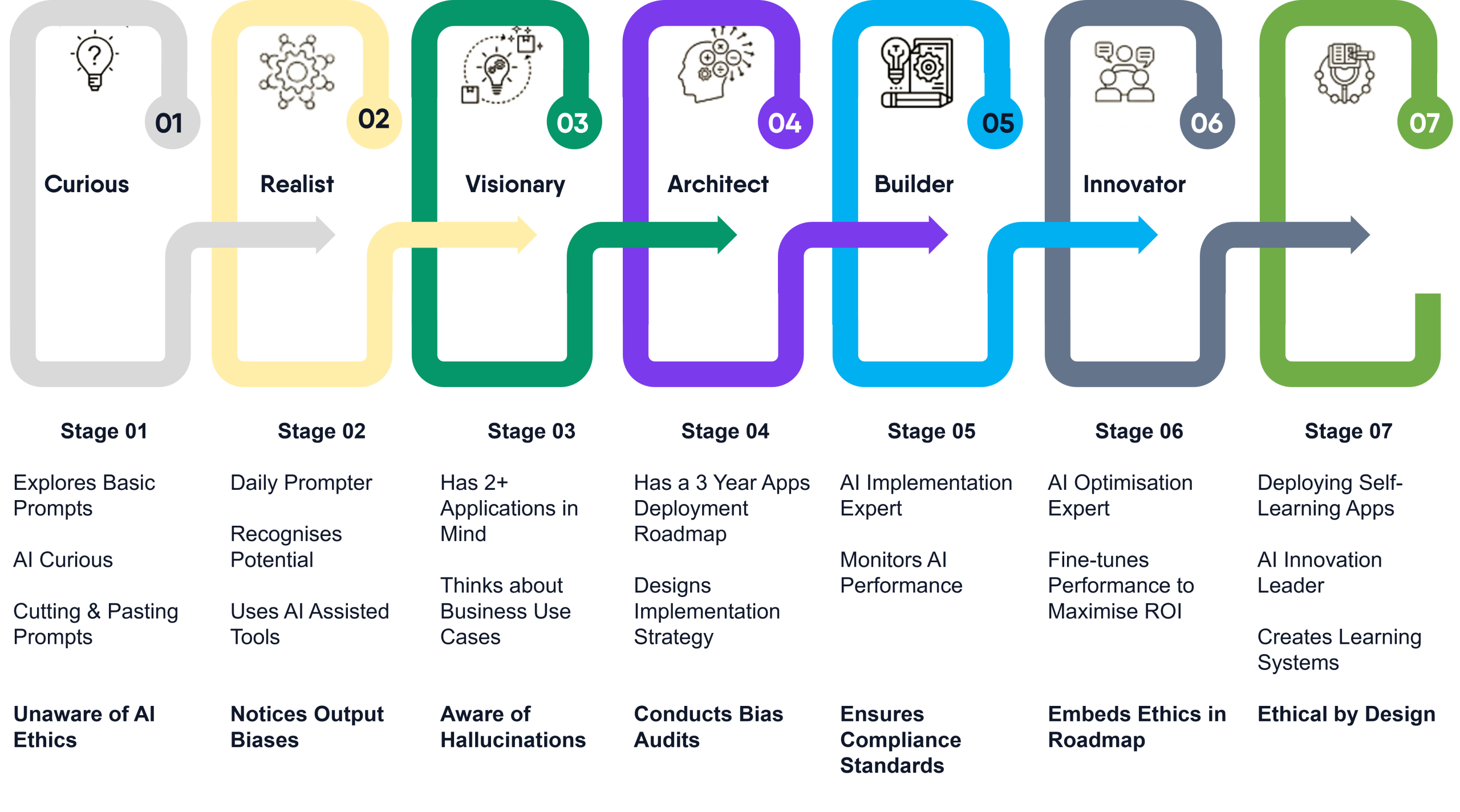
The 7 Stages of AI Readiness
Where apprentices start: Curious & Realist. Basic prompting, informal tool use, general awareness of AI potential without structured application capability.
Where they arrive by month four: Architect & Builder. Three-year deployment roadmap, implementation strategy, bias audits, AI applications built and deployed.
All three apprentices in these case studies entered at Stage 1–2. The methodology described in the next section is what drives that progression — and the case studies are the evidence that it is real.
ABOUT THE PROGRAMME
ST0117 with AI Integration
The ST0117 Level 4 Business Analyst is a UK government-recognised apprenticeship standard covering 71 Knowledge, Skills, and Behaviours — 28 Knowledge, 30 Skills, and 13 Behaviours. Delivered over eleven months, it culminates in an End-Point Assessment comprising a Project Proposal with Presentation and a Professional Discussion underpinned by portfolio evidence.
What distinguishes this programme from standard ST0117 delivery is the integration of AI application development throughout — from prompt templates deployable in a day to multi-agent agentic systems. Apprentices learn to analyse business processes, identify AI opportunities across a five-category complexity framework, evaluate each on a full ROI basis, and build the solutions themselves.
The programme is developed and taught by Dhiren Master, former partner at Monitor Company (global strategy consultancy), with over three decades of strategy consulting and senior executive experience across 26 countries. Full-stack developer, data scientist, Machine Learning specialist, and Agentic AI application developer.
Team Enrolment — Why 2 or More Employees Is the Right Investment
At £900 per apprentice for non-levy employers, this programme is not just a development opportunity for an individual — it is a capability-building investment for a team. The more employees enrolled, the greater the depth of AI knowledge embedded across the organisation, and the faster the implementation momentum. The right number is 2+ dependent on the size and complexity of your organisation.
One of our current employer partners is a domiciliary care provider with 200 carers and a management team of 10. They are enrolling 6–8 of their head office and management staff simultaneously — building a cohort of AI-capable business analysts who will collectively map the organisation’s operations, identify its AI opportunities, and build the tools to address them, each from their own functional vantage point. That is not a training exercise. That is an organisational transformation programme — at an apprenticeship cost.
PART ONE
The Approach: How We Move People from Stage 1–2 to Stage 4–5
The four analytical disciplines below are the practical tools through which AI maturity progression happens. Each builds on the previous. Together, they are why an apprentice at Stage 1–2 on day one is operating at Stage 4–5 by month eleven.
Structured Elicitation
One-to-one structured interviews with every person who runs the business. Not surveys — conversations that surface what people actually do, not what the procedure says. The most important distinction in business analysis is between the intended process and the actual one: the spreadsheet that sits alongside the official system because the official system cannot do what is needed; the single person whose personal skill is carrying a critical function that should long since have been systematised. Twenty-eight-plus structured interviews were conducted across the three businesses.
Process Pipeline Mapping
Elicitation reveals the ingredients. Pipeline mapping assembles them into a coherent picture of the operation end to end — every stage documented with roles involved, typical inputs and outputs, tools used, most common failure modes, and a risk rating for the probability and cost of failure. Once a process is mapped, the stages that are candidates for AI intervention become visible wherever they occur.
AI Opportunity Classification
Not all AI opportunities are equivalent in complexity, cost, or risk. The skill of the BA is knowing which category each opportunity belongs in — and why. Over-engineering a Category 1 problem wastes months of development resource. Under-resourcing a Category 4 problem produces a half-built system that creates more work than it saves.
| Category | Description | Typical Build Time |
|---|---|---|
| 1 | Off-the-shelf tool configuration | 1 day |
| 2 | Standalone Prompt Engineering | 1–2 days |
| 3 | Prompt + Integration with Existing MIS Software | 3–4 days |
| 4 | Multiple Agentic Agents Working Together | 10+ days |
| 5 | Full build standalone agentic application | 3–6 months |
The ROI Framework
Every AI opportunity is a commercial decision. The framework provides a consistent, auditable method: development cost (external contractor days at £700/day + internal training + software), annual saving (time recovered × £200/day staff rate + revenue improvement), ROI percentage, payback period in months, and a build-vs-buy threshold — the maximum monthly SaaS cost at which buying a third-party platform is more financially attractive than building custom. This transforms a list of ideas into a prioritised, phased implementation plan with a defensible financial case for each item.
PART TWO — THE CASE STUDIES
The Multi-Site Dental Group
The Core Finding
This practice was not losing revenue it had already generated. It was failing to generate revenue it had already earned the right to — and losing it at multiple points across the entire patient journey. The elicitation and pipeline mapping revealed not one revenue problem but a chain of interlocking failures, each invisible on its own, collectively significant.
Selected AI Buddies — Top Priority
Plus 28 further AI Buddies, including 14 deployable immediately via prompt templates. Full catalogue available on request.
The Key Insight
The revenue story in this business was not one problem — it was five problems operating simultaneously, each invisible in its own way. Leads never answered do not appear in any report. Treatments never identified do not show up as declined proposals. Treatment plans never followed up do not appear as missed invoices. Quality risks with no monitoring system produce no alert until something goes wrong. A Business Analyst who maps the patient journey end to end makes the invisible visible — at every stage, not just the most obvious one.
The Premium Cabinetry Studio
The Core Finding
A team with every ingredient for exceptional success — and a set of operational and strategic conditions preventing those ingredients from combining effectively. The owner’s own diagnostic was precise: “I have to ask designers what they are working on right now. I shouldn’t have to ask.”
The market had shifted materially: a significant post-pandemic influx of high-net-worth residents created a growing pool of premium clients. The business had the skills to serve them but not the systems.
Three Client Segments Identified
Consistent income but highly competitive, margin-constrained, and facing economic headwinds as this group defers discretionary spending.
~50% of the market by volume. Psychologically complex: clients who conceal their real budget ceiling and require skilled commercial handling to unlock it.
Not economically constrained. Deeply loyal once trust is established. A single relationship — with its repeat projects and peer referrals — can sustain a significant portion of a business’s revenue independently.
Strategic recommendation: build the operational infrastructure to serve Segment 2 reliably, then use that as the foundation for a deliberate transition toward Segment 3 over three to five years.
The 22-Stage Pipeline — High-Risk Stages at Every Transition
Enquiries tracked in email threads or individual memories. Qualification conducted differently by each team member. Designers following leads into full design investment on projects that would not convert.
Site measurement is the highest-risk activity — errors create expensive rework downstream. Budget conversation happened at the end of the design process. The £40k-expectation-meets-£109k-proposal scenario occurred repeatedly.
The highest-risk single stage. Ordering errors — wrong dimensions, wrong finishes, missing items, supplier nomenclature mismatches — creating costly rework and damaged supplier relationships.
Lead-time tracking manual. Pre-installation site checks not consistently performed. “Every floor is out of level. Knowing this before installation day is the difference between a clean project and a costly delay.”
When preparation was thorough, the team delivered exceptional work. When it was not, consequences cascaded: return visits, remediation costs, delayed sign-offs, disputed final invoices.
Two team members maintained exceptional client relationships by personal habit, not business process. The commercial value of a systematised aftercare programme for Segment 3 clients was not being captured.
33 AI Buddies identified across three implementation tiers (0–60 days, 60–120 days, 120+ days). The single Category 5 build — the Order Review and Validation Buddy — runs three parallel validation checks on every submitted order, flagging every discrepancy for designer sign-off before submission.
The Key Insight
The AI Buddies are not replacements for human expertise — they are the scaffolding that makes expertise transferable, consistent, and scalable. The BA’s distinctive contribution was not identifying what the technology could do. It was standing outside the process, mapping it end to end, and surfacing exactly where the operational friction was concentrated and what kind of intervention would address it at the right level.
The Regional Insurance Brokerage
Five Interlocking Structural Problems
26 AI Solutions Across Six Functions
Unlike the dental practice or cabinetry studio, the brokerage’s AI opportunity sat across six parallel operational functions. Ten of the 26 solutions fell in Categories 1–2 — achievable without an external developer and without touching the CRM. Of the eight Category 4 solutions, the most commercially significant were: 100% call monitoring (from 3–4% current); a WhatsApp marketing chatbot for the Heritage season; a real-time cross-sell identification system; and the Underwriter Knowledge Base — capturing a departing specialist’s expertise before the window closed permanently.
One Category 4 solution was deferred — not because it cannot be built, but because the operational environment makes it fragile. Knowing when not to build is as important as knowing how.
The Key Insight
AI opportunity is not concentrated in one part of a business. It is distributed across every function that contains rule-based work, manual reporting, inconsistent knowledge access, or unmonitored performance. A Business Analyst who cannot distinguish between a Category 1 problem and a Category 4 problem wastes the organisation’s time and money on both. Getting that distinction right — and building the case for each at the appropriate level of investment and urgency — is the skill this programme develops.
Portfolio Statistics — Three Businesses at Month Four
| Dental Group | Cabinetry Studio | Insurance Brokerage | Total | |
|---|---|---|---|---|
| Stakeholder interviews | 12 | 6 | 10+ | 28+ |
| Pipeline stages mapped | 45+ | 22 | Multiple | 70+ |
| Category 1 — Off-the-shelf configuration | 0 | 2 | 5 | 7 |
| Category 2 — Standalone Prompt Engineering | 4 | 5 | 5 | 14 |
| Category 3 — Prompt + MIS Integration | 24 | 18 | 7 | 49 |
| Category 4 — Multiple Agentic Agents | 4 | 7 | 8 | 19 |
| Category 5 — Full build standalone app | 2 | 1 | 1 | 4 |
| Total AI opportunities | 34 | 33 | 26 | 93 |
PART THREE — SYNTHESIS
Five Problems Every Organisation Has
Three businesses. Three different sectors, sizes, customer profiles, regulatory environments, and commercial models. And the same five problems — in different forms — in every one.
Lost Leads at the First Touchpoint
Revenue the business had already invested in generating — through marketing and reputation — was leaking away at the very first stage of the pipeline. The cost of recovering a lead that has already shown intent is low. The cost of regenerating intent from a cold prospect is high. Every business in this portfolio was paying the second cost because they were failing to manage the first.
Knowledge in One Person’s Head
In all three businesses, performance on critical tasks was a function of who happened to be available — not of what the business had systematised. The dental conversion rate depended on one front desk lead. The cabinetry studio’s commercial instinct was the property of two senior people. The brokerage faced the imminent departure of a product expert whose knowledge would leave with him.
Manual Data Entry at Every Decision Point
The dental group’s insurance breakdown form had 40–50 data points to transcribe manually. Clinical notes were written from memory at 75–80% accuracy. The cabinetry studio’s weekly review consumed 4.5 hours of management time that the pipeline system should have reported automatically. The brokerage’s double-entry problem spanned 14 insurer portals. Significant professional time was being consumed by rule-based work that no professional should be doing in 2026.
The Handoff Problem
Value is lost at every transition between people, roles, and systems. The dental treatment co-ordinator received “they need a crown” as her complete briefing before a £2,000+ conversation. The cabinetry studio’s designers had no standard way to brief the installation team. The brokerage’s Heritage lead handoff lived in a shared spreadsheet and a checkbox. In each case, the person receiving the handoff was working with insufficient context and bearing the cost of failures the person who passed the work would never see.
Invisible Revenue
Revenue not generated is invisible in a way that revenue lost is not. A patient enquiry never answered does not appear in any report. A treatment never identified does not show up as a declined proposal. A cross-sell opportunity never raised does not appear as a missed sale. In all three businesses, the amount of revenue never generated substantially exceeded the amount of revenue lost after initial generation.
A Business Analyst who maps the pipeline end to end makes the invisible visible.
ST0117 KSB Evidence Across the Three Case Studies
The following table shows how the analytical work produced across all three businesses maps to the Knowledge, Skills, and Behaviours at the core of the ST0117 standard. These are not fabricated portfolio entries — they are the direct outputs of the methodology applied in each engagement.
| KSB Area | Evidence in Each Case Study |
|---|---|
| Business analysis planning and monitoring | Structured elicitation plans, interview frameworks, pipeline mapping methodology |
| Stakeholder analysis and management | 6+ interviews across diverse roles; stakeholder influence and interest mapping |
| Investigation and analysis | Process pipeline maps; gap analysis; root cause identification across multiple processes |
| Requirements engineering | 25+ AI opportunity specifications with complexity, effort, and ROI analysis |
| Business case and benefits realisation | Full ROI portfolio; payback period analysis; build-vs-buy threshold framework |
| Strategic context and environment | Market segmentation analysis; competitive landscape; regulatory environment review |
| AI application development | Three applications built by month four; full professional tech stack demonstrated |
| Ethics and responsible AI | HIPAA, FCA, and GDPR considerations embedded throughout all three case studies |
| Change management | Adoption design principles applied across all three business contexts |
The Investment Case
There are businesses that spend £100,000–£250,000 on external consultants to produce an AI transformation strategy, a further £250,000–£400,000 having that strategy’s priority applications built out, and then £30,000–£50,000 every year in ongoing fees. The documents and the applications remain. The knowledge, the context, and the capability to do it again — does not. The three businesses in these case studies took a different route.
Strategy and Roadmap
External: £100k–£250kInternal: £0 additional cost
Producing a credible AI transformation strategy — stakeholder elicitation, end-to-end pipeline mapping, 20+ AI opportunity specifications with complexity and feasibility assessment, phased implementation planning — requires senior analytical expertise and genuine time inside the business. The apprenticeship route produces the same output. The cost difference: the levy, which is already paid.
Build-Out
External: £250k–£400kInternal: dramatically reduced
The apprentice builds AI applications personally during the programme. An internal BA who can write a well-scoped, category-classified specification also reduces external build cost by 20–30% across a portfolio, by eliminating the ambiguity that generates expensive development iterations.
Business Impact of Deployed AI
These are not projections from a vendor brochure. They are grounded in the specific findings across the three case studies.
Build Capability, Not Dependency
Ongoing consultancy: £30k–£50k/yrInternal route: £0
The consultancy model builds capability in the consultant, not in the business. The apprentice who produced these case study outputs will still be in the business next year, at a higher stage of the AI maturity framework, capable of planning the next iteration at no additional cost. The ongoing consultancy cost disappears entirely.
Net Cost
(payroll > £3m)
(govt meets 95%)
The Full Comparison
| Dimension | External Route | Internal (Apprenticeship) Route |
|---|---|---|
| Strategy and roadmap | £100,000–£250,000 | £0 additional cost |
| Build-out of 30+ solutions | £250,000–£400,000 | Progressive build; external costs reduced 20–30% |
| New customer acquisition | 20–40% increase | Available to both routes |
| Customer lifetime value | 10–30% increase | Available to both routes |
| Operating cost reduction | 10–20% | Available to both routes |
| Quality improvement | 30–60% | Available to both routes |
| Ongoing maintenance | £30,000–£50,000/yr | £0 — internal capability retained |
| Net cost (non-levy employer) | — | £900 per apprentice |
| Year-one cost avoidance | — | £350,000–£650,000 |
The three businesses in this portfolio did not spend £250,000 on consultants. They spent eleven months building something better: an internal person who could see what their business needed, specify it rigorously, and then build the first wave of it themselves — with full context, full commitment, and no exit date.
Stage 4 in four months. Stage 5+ within two to three years of continued practice. Not a document. A person. In the business. Getting better.
Take the Next Step
The work in this document was produced by apprentices at month four of eleven. There are seven months still ahead. If what you have read prompts a question — about the programme, your levy position, or what an AI-integrated BA apprenticeship would produce in your sector — the right next step is a discovery conversation.
Training Providers
Seeking to deliver the ST0117 AI-integrated programme or explore partnership arrangements: contact us to discuss delivery models and commercial terms.
Employers
Looking to enrol one or more apprentices or understand your levy eligibility: book a thirty-minute discovery call. No obligation. No jargon.
Individuals
Interested in the apprenticeship route: we can walk you through the programme structure, the time commitment, and what the journey from Stage 1–2 to Stage 5–6 actually looks like.