
AI Framework
Roadmap for
Business Leaders
From Basic Prompting to Enterprise AI Architecture — a practical seven-level progression guide for organisations serious about AI transformation.
A Roadmap for Every Stage of the Journey
This roadmap helps business leaders understand how their AI capabilities and framework needs evolve as their organisation becomes more AI-ready.
Each of the seven levels represents a natural progression in both organisational maturity and technical sophistication, with clear triggers that indicate when to transition to the next framework. The progression is sequential — each level builds the capabilities required for the next. Skipping levels is the single most common cause of expensive AI initiative failure.
Most organisations will find the greatest near-term value at Levels 3–4, where AI moves from individual productivity to autonomous business process automation. The majority do not need Levels 6–7 — and attempting them without mastering the earlier stages almost always produces costly, unmaintainable systems.
This document will help you identify where your organisation currently sits, what it takes to progress, who to trust to guide that progression — and the most direct funded route to getting there.
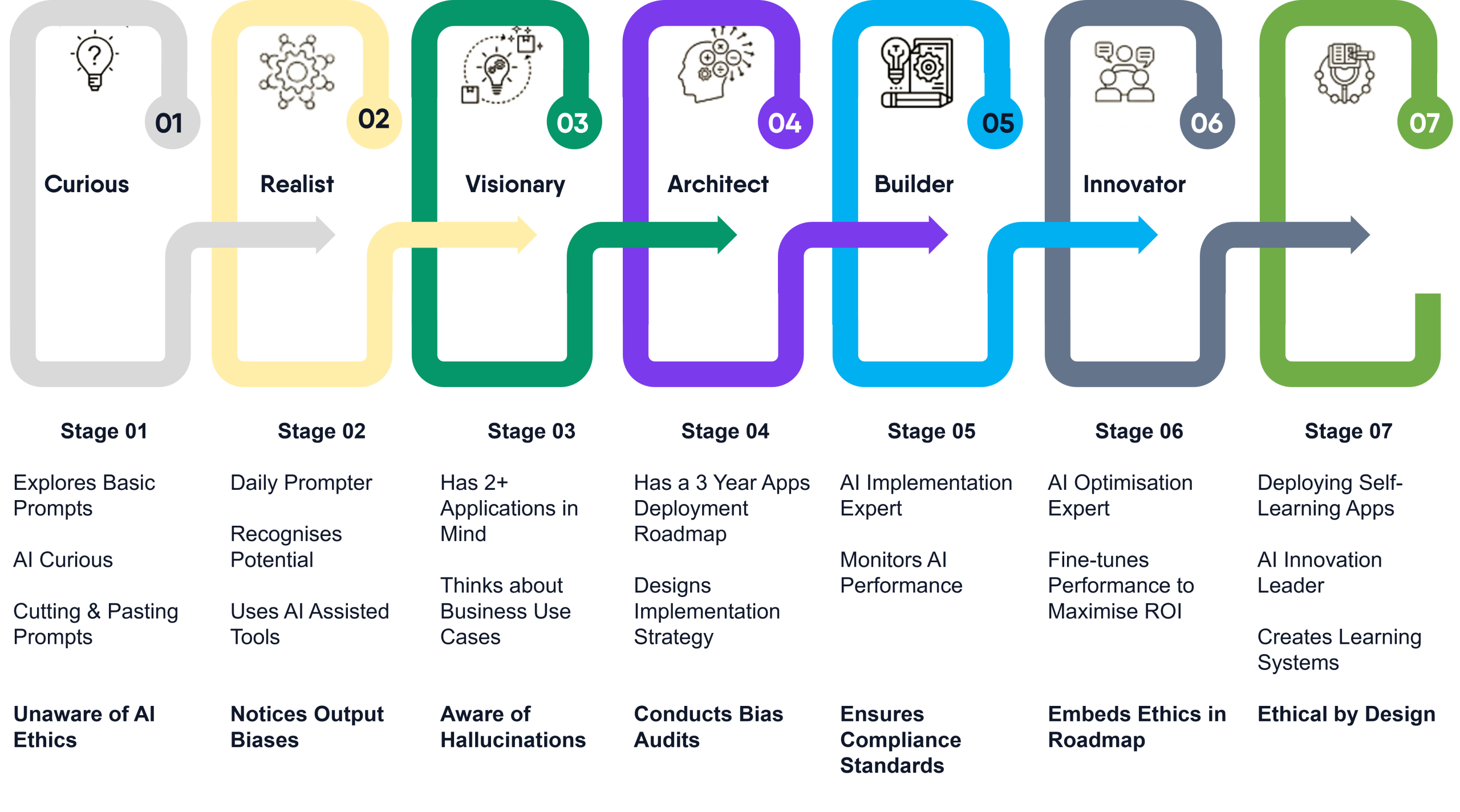
The 7 Stages of AI Readiness
Most business professionals — including many senior ones — sit at Stage 1 or Stage 2. They have experimented with AI tools, can prompt a chatbot, and notice when outputs are obviously wrong. What they cannot yet do is translate that awareness into a specific, financially grounded, operationally rigorous plan for what their organisation should build — and in what order.
Where AI Solutions apprentices start: Curious & Realist. Basic prompting, informal tool use, general awareness of AI potential without structured application capability.
Where they arrive by month four: Architect & Builder. Three-year deployment roadmap, implementation strategy, bias audits, AI applications built and deployed.
Basic Prompting
Framework: Simple one step prompts : Claude, ChatGPT, Gemini
What You’re Doing
- Individual employees using AI for personal productivity
- Basic question-and-answer interactions
- Simple content creation and editing tasks
- Ad-hoc problem solving and research
- Email drafting, summarisation, meeting note processing
Business Impact
15–30% productivity gains for individual tasks. Improved writing quality, faster information processing, reduced time on routine cognitive work.
Investment Required
- £20–100 per person per month in AI subscriptions
- Basic prompt training
- No technical infrastructure required
When employees are spending 2+ hours daily on prompting and asking for consistent, repeatable workflows across teams.
Prompt Engineering
Framework: Basic Prompt Engineering
What You’re Doing
- Systematic prompt engineering with reusable templates
- Chain-of-thought and few-shot prompting techniques
- Custom prompt libraries for specific business functions
- Advanced output formatting and constraint management
- Standardised content creation workflows across teams
Business Impact
40–60% productivity gains in knowledge work. Consistent quality across team outputs. Reduced training time for new employees through standardised AI processes.
Investment Required
- Advanced prompt training
- Prompt library development and maintenance
- Basic workflow documentation and quality assurance
When you need multiple AI specialists working together on complex tasks, or when you want to automate multi-step business processes without human intervention.
Create Agentic AI Agents
Framework: Advanced Prompt Engineering + Custom Prompt Libraries
What You’re Doing
- Building automated workflows with multiple AI agents
- Creating business process automation without coding
- Connecting AI to existing business tools: CRM, email, databases
- Designing workflows that run autonomously, 24/7
- Lead qualification, content pipelines, customer support routing
Business Impact
60–80% reduction in routine process time. 24/7 automated operations. Improved data consistency and faster response times to customers and opportunities.
Investment Required
- £500–2,000 per month in platform costs
- Business process analysis/optimisation for process owners
- Process mapping and workflow design time
- Eliminate hallucinations
- Integration setup with existing systems
When you need multiple agent orchestration, custom business logic, integration with MIS.
Multi-Agent Orchestrated Frameworks
Framework: Langchain, n8n, MAKE or Zapier
What You’re Doing
- Designing teams of specialist AI agents that collaborate
- Creating custom business logic with minimal coding
- Building sophisticated reasoning and decision-making workflows
- Human in the loop design
- Ensuring compliance
- Developing domain-specific agent expertise at scale
- Market research, financial analysis, and product development teams
Business Impact
Complex business problems solved autonomously. Higher-quality outputs through agent specialisation. Reduced dependency on expensive external consultants for analysis and decision support.
Investment Required
- £200–500 per month in development and platform costs
- Basic Web Development training for key personnel
- Advanced Prompt Engineering training for key personnel
- Process analysis and agent design workshops
- Custom workflow development time
When you need enterprise-grade security, compliance features, or complex enterprise system integration, or when agent reliability becomes business-critical.
Low-Code Web Cloud Based Platforms
Framework: Streamlit, Github, Render/Railway, Python, LangGraph, LangSmith
What You’re Doing
- Building enterprise-grade AI agent systems at scale
- Implementing robust security and compliance measures
- Integrating with complex enterprise infrastructure
- Managing large-scale, mission-critical agent deployments
- Regulatory compliance monitoring and strategic intelligence
- Basic self-learning agents
Business Impact
Mission-critical business processes fully automated. Enterprise-scale cost savings. Competitive advantage through AI-driven insights. Reduced operational risk through automated compliance and governance.
Investment Required
- £500–5,000 per month in platform and infrastructure
- Enterprise architecture and security planning training
- Basic web development and deployment training
- Integration with existing enterprise systems
- Dedicated AI operations team
When you need complete customisation, want to own your AI infrastructure, or when your AI systems become a core competitive differentiator requiring maximum flexibility.
Full Development Flexibility
Framework: Python, Cloud Development, AWS/Azure/GCP, DsPy — custom development for proprietary AI capabilities
What You’re Doing
- Building completely custom AI agent architectures
- Creating proprietary AI capabilities as competitive moats
- Complex orchestration of multiple AI models simultaneously
- Building AI products for external customers
- Novel customer experience and business model innovation
Business Impact
Unique competitive advantages through AI innovation. New revenue streams from AI-powered products. Complete control over capabilities and costs. Foundation for AI-driven business model transformation.
Investment Required
- £5,000–20,000+ per month in development
- Dedicated AI engineering team: 3–10 people
- 6–18 months to initial production systems
- Ongoing maintenance and evolution capability
When you are running AI systems at scale and need sophisticated model lifecycle management, continuous improvement, and operational excellence.
MLOps and Self-Evolving Systems
Framework: Advanced MLOps Platforms + Custom Infrastructure
What You’re Doing
- Managing the complete lifecycle of AI models in production
- Implementing continuous learning and improvement systems
- Operating AI at enterprise scale with operational excellence
- Building self-evolving AI capabilities
- A/B testing, automated deployment, model governance at scale
Business Impact
AI systems that improve automatically over time. Operational excellence in AI delivery. Minimised system downtime. Maximised ROI from AI investments through continuous optimisation.
Investment Required
- £20,000–100,000+ per month in infrastructure
- Specialised MLOps engineering team
- Advanced monitoring and analytics infrastructure
- Comprehensive governance and compliance systems
Level 7 is operational AI excellence — systems that improve, deploy, and govern themselves. Few organisations need this now. The right destination for most is Levels 3–5.
For Every Level, Ask These Questions
Before progressing to any new level, run this four-part evaluation. The questions are simple; the discipline of answering them honestly is what most organisations skip.
1. Readiness Assessment
- Do you have the technical capabilities in-house?
- Is your organisation ready for this level of complexity?
- Do you have the budget and resources to sustain it?
2. Business Case Evaluation
- What specific business problems does this level solve?
- What is the expected ROI and realistic timeline?
- How does this align with your competitive strategy?
3. Risk Management
- What are the implementation risks at this level?
- How will you maintain business continuity during transition?
- What is your rollback plan if the level proves too complex?
4. Success Metrics
- How will you measure success at this level?
- What KPIs signal readiness for the next level?
- How will you track ROI and business impact over time?
- Don’t skip levels — each builds what the next requires
- Invest in training — capability must match complexity
- Start small — pilots reduce risk and build confidence
- Plan transitions — anticipate when you’ll outgrow each level
- Maintain focus — master fundamentals before advancing
- Measure everything — validate ROI before progressing
Why Most AI Initiatives Fail
The technical progression in this roadmap is straightforward. The real challenge is finding the expertise to guide your organisation through it without the costly mistakes that afflict the majority of AI initiatives.
The AI training market is flooded with self-proclaimed experts who lack real implementation experience. Understanding the archetypes helps you avoid them — and the expense of learning the hard way.
Four Trainer Archetypes to Avoid
The vast majority of AI trainers fall into one of these four categories. Each causes a distinct and expensive pattern of failure that is almost always attributed to “AI not being ready” — when the real cause is the quality of the guidance.
The ChatGPT Enthusiast
Used ChatGPT for six months; now calling themselves an AI expert.
- Cannot explain the difference between temperature settings and model parameters
- Has never built anything beyond basic prompts
- Uses buzzwords without understanding: “agentic,” “RAG,” “fine-tuning”
The Academic Without Implementation
Understands AI theory but has never deployed a production system.
- Teaches frameworks that don’t survive contact with real business data
- Has no answer for operational failure modes and real-world edge cases
- Cannot help you build what they describe — only describe it
The Consultant Selling Dreams
Generic business consultant who added “AI” to their service list.
- Promises unrealistic outcomes — “AI will solve all your problems”
- Cannot code, has never built AI systems, relies on vendor demos
- Pushes expensive enterprise solutions regardless of actual business need
The Framework Evangelist
Works for, or is heavily invested in, one specific AI platform.
- Every problem gets solved with their preferred framework
- Cannot objectively compare alternatives — has no incentive to
- Dismisses simpler solutions that would serve your business better
Questions to Ask Any AI Trainer
Before engaging any AI trainer or transformation partner, ask these five questions. The answers will tell you within ten minutes whether you are talking to a practitioner or a presenter.
- “Show me a production AI system you have built that processes real business transactions.” The wrong answer is a demo, a prototype, or “I have advised companies who built this.” The right answer is specific examples with business metrics and real user adoption data.
- “What is the biggest AI implementation failure you have experienced, and what did you learn?” The wrong answer is “all my implementations have been successful.” Every practitioner who has operated at scale has failed at something. What they learned is what matters.
- “How do you decide whether to use CrewAI, LangChain, or a no-code tool for a specific business problem?” The wrong answer is always recommending the same solution, or an inability to articulate trade-offs. The right answer is a clear decision framework based on business context, scale, and internal capability.
- “What is your experience with P&L responsibility, budget management, and ROI measurement?” The wrong answer is “I focus on the technical side.” The right answer is specific examples of managing AI budgets and measuring business impact at a meaningful scale.
- “Can you write and deploy the code for the systems you are teaching?” The wrong answer is “I am more of a strategic advisor” or “I have a technical team for that.” The right answer is a demonstrated, provable ability to build, troubleshoot, and deploy — not just describe.
Why Depth of Experience Changes Everything
Most AI trainers can explain what you should do. Very few have spent three decades doing it — across strategy, operations, marketing, entrepreneurship, and software development — at the level where the consequences are real.
The Analytical Foundation
Cambridge Engineering MA (Hons, Entrance Exhibitioner) — one of the world’s most rigorous analytical programmes, built on solving problems that don’t yet have textbook answers. INSEAD MBA with Distinction across all five periods — among a small cohort each year to achieve that standard.
Strategy at the Highest Level
Monitor Company (strategy consulting), then Head of Strategy Worldwide at BG Group — advising the Board on £1 billion of annual capital investment across 26 countries. At that level, a poor recommendation does not waste a budget line. It costs a company its position in markets that matter.
Marketing, Operations and Commercial Rigour
Marketing Director at Kwik Fit, then Global CMO at Salary Finance (fintech). Both roles demanded the same discipline: understanding what actually drives behaviour, measuring what works, and deploying resource where it generates return. That commercial rigour separates AI programmes that produce metrics from those that produce revenue.
Building World Firsts
Eight businesses founded over three decades. First optical broadband network of its kind in India (2001). Therma Blade — the world’s first heat-generating ice hockey skate blade: £14 million raised, 3 patents covering 35 product features, NHL team adoption (2008). 5 international patents across his career, 2 currently provisional.
He Builds What He Teaches
Full-stack developer and data scientist. Designs and builds production AI systems — Python, AWS, Next.js, GraphQL, machine learning pipelines for predictive analytics. If your trainer cannot write and deploy the code they are describing, you are paying for commentary, not capability.
5 International Patents · 5 Marketing Awards
Proven ability to innovate, protect, and commercialise novel solutions across engineering, marketing, and technology. Combines analytical rigour with creative problem-solving, and holds himself accountable for real-world, measurable outcomes.
Dhiren has taken three organisations from Level 1–2 — ad-hoc prompting, no AI strategy — to Level 5 enterprise agent infrastructure in seven months. In production environments. With real business processes and measurable outcomes.
That is the only kind of evidence worth weighing when you are deciding who should guide your organisation’s AI transformation.
Your Funded Route to Levels 3–5
Understanding where your organisation needs to be is useful. Having a structured, funded route to get there is transformational.
Why the Business Analyst is the AI Linchpin
At Levels 3–5 — the range where most organisations need to operate to remain competitive — the role that sits at the centre of successful AI deployment is not the CTO or the data scientist. It is the Business Analyst: the person who bridges business requirements and technical implementation, maps processes, identifies automation opportunities, and ensures AI systems solve the right problems.
Most organisations attempt to develop this capability through expensive external consultants, short courses with no sustained delivery, or ad-hoc internal upskilling. There is a better route.
The ST0117 Level 4 Business Analyst Apprenticeship
A government-funded, 11-month programme delivered alongside the day job, in your own organisation. The only funded route specifically designed to develop AI-capable Business Analysts who operate at Levels 3–5 of this framework.
Apprentices work through 71 Knowledge, Skills and Behaviours covering the full scope of business analysis practice. They also build five progressively complex AI applications as their assessed portfolio:
These are not illustrative exercises. By the end of the programme, your Business Analyst will have built and deployed real systems that sit squarely at Levels 3–4 of this framework.
What It Actually Costs
The programme is funded through the UK Government’s apprenticeship levy:
| Employer Type | Your Cost | DfE Funding Per Apprentice |
|---|---|---|
| Non-levy employers (most businesses under ~£3m annual payroll) | £900 (5% contribution) | £17,100 |
| Levy-paying employers | £0 — drawn from your levy account | Up to £18,000 |
For most mid-sized businesses, developing an AI-capable Level 4 Business Analyst costs under £1,000. No other route to this capability comes within an order of magnitude of that value.
The Next Step
Contact us to establish where your organisation currently sits on this framework, identify the most practical route to Levels 3–5, and determine whether the ST0117 apprenticeship is the right vehicle for your team.
Get in Touch →The Path Is Clear — Expertise Is the Variable
This roadmap provides a clear technical path from basic AI usage to advanced AI operations. The progression itself is not complicated. What most organisations underestimate is how much the quality of expertise guiding that journey determines whether it succeeds or fails.
The key is matching your framework choice to your organisation’s current AI readiness — and ensuring that the person guiding your progression has genuinely built and operated these systems, not merely described them to other organisations.
Most organisations will find the greatest value at Levels 3–4. That is where AI moves from a productivity tool to a genuine operational capability — and where the Business Analyst becomes the most important strategic hire in the AI transformation. The AI Solutions (ST0117++) apprenticeship is the most cost-effective route to building that capability internally, at scale, with government funding covering the majority of the cost.
The question is not whether to make this transition. It is how to make it without the costly mistakes that derail the majority of AI initiatives — and who you trust to guide it.